Guide
Are scaffold tags
a legal requirement?
In New Zealand, yes — for every scaffold, regardless of height. In Alberta, yes, and the Code lists exactly what the tag must carry. In Ontario, British Columbia, the UK and under Australian model guidance, no. Here is what each regulator actually says, quoted, with the sources.
New Zealand
Yes
All scaffolds, regardless of height, must have a tag at access points, and WorkSafe lists what it has to show.
United Kingdom
No
Fixing tags is not mandatory. Inspection and recording in the scaffold register are. NASC recommends electronic devices anyway.
Australia
Not in the guidance read
Safe Work Australia’s inspection guide does not mention tags. NSW treats them as useful, but not a substitute for a handover certificate.
Canada — Alberta
Yes
Colour-coded tags at every point of entry, five things the tag must carry, and a 21-day expiry on site-built scaffolds.
Canada — Ontario
No
No tagging provision anywhere in O. Reg. 213/91. Taller scaffolds need a written statement against the design drawings, kept at the project.
Canada — British Columbia
No
Part 13 has no tagging provision at all. A work platform must be inspected before use on each shift, with no artefact required.
New Zealand — mandatory, with a defined content set
WorkSafe New Zealand’s Good Practice Guidelines are unambiguous. All scaffolds, regardless of height, must have a tag clearly displaying important safety information at access points. There is one narrow exception: minor scaffolds may be excluded where appropriate for the situation, meaning lightweight, portable, single-bay scaffolds with a working platform no higher than 2 metres.
The guidelines also list what the tag has to carry, and it is more than a date. The status of the scaffold — SCAFFOLD SAFE or SCAFFOLD UNSAFE. The name and contact phone number of the certified scaffolder, or the erector if the scaffold is under 5 metres. The purpose or intended use. The duty loadings. The maximum number of platforms or bays that may be loaded. Any limitations on use. And a record of each inspection, including who inspected or altered the scaffold and when.
That last item is the one that catches people out. Inspection records can sit on a separate register or on the tag itself — WorkSafe allows either — but they have to exist and be signed by whoever carried out the inspection, and the record or register must be kept on site.
United Kingdom — not required, and recommended anyway
The UK position is the one most often misrepresented, usually by people selling tags. NASC guidance draws a clear line between what the law compels and what industry recommends.
What is mandatory is inspection and the paperwork behind it. Under regulation 12 of the Work at Height Regulations 2005, a working platform from which someone could fall 2 metres or more must be inspected before first use, at intervals of no more than 7 days, and after anything liable to jeopardise its safety. The inspector must produce a report containing the eight Schedule 7 particulars. Recording in the scaffold register is mandatory. Hanging a tag is not.
That does not make tags pointless — NASC says the opposite in the same breath. But a UK contractor who tells you tags are a legal requirement is wrong, and a supplier who implies it is selling on a false premise.
“While scaffold inspections and recording in the scaffold register are mandatory, the fixing of scaffold inspection tags or electronic scaffold inspection devices is not; however, the latter are very useful in informing workers that the scaffold is safe (or unsafe) to work on and are recommended by the NASC.”
Australia — and why a tag is not a handover certificate
Safe Work Australia’s Guide to Scaffold Inspection and Maintenance does not mention scaffold tags at all. What it requires is that unauthorised access is prevented while a scaffold is incomplete or unattended — a control, not a specific artefact. How you achieve that is left to you.
SafeWork NSW’s Scaffolding Industry Safety Standard goes further, and its wording is worth reading closely if you have ever been told a tag covers your handover obligations. It describes tags as a useful indicator at the entry point of when the scaffold was last inspected — and then says plainly that they typically do not include the minimum amount of information required for a valid handover certificate, and so cannot be used as one.
For incomplete scaffolds the same standard asks for access to be physically blocked and for signage that clearly indicates access is not allowed, including phone contact details for the responsible scaffold company or authorised person.
One honest caveat: this section reflects Safe Work Australia’s model guidance and the NSW standard, which are the two documents we have read in full. Victoria is not a model WHS jurisdiction and other states publish their own instruments. Check what applies where you work rather than assuming a national answer.
“They typically do not include the minimum amount of information required for a valid handover certificate, and thus cannot be used as such.”
Canada — Alberta requires a tag, and lists what goes on it
Canada has no national scaffold regulation. Occupational health and safety is provincial, the provinces disagree with one another, and so the question this page asks has no single Canadian answer. Alberta’s answer is the most emphatic yes in any market covered here — more emphatic than New Zealand’s, because it sits in the Code itself rather than in a good practice guideline.
Section 326 of Alberta’s Occupational Health and Safety Code requires an employer to ensure that a scaffold is colour coded using tags at each point of entry indicating its status and condition: a green tag reading Safe for Use, a yellow tag reading Caution: Potential or Unusual Hazard, or a red tag reading Unsafe for Use.
The inspection cycle attaches to site-built scaffolds, which the Code names individually — bracket, double-pole, needle-beam, outrigger, single-pole, suspended and swingstage. Those must be inspected and tagged by a competent worker before first use, and at intervals of not more than 21 calendar days while workers work from the scaffold or materials are stored on it. A tag expires 21 calendar days after the inspection it records. One erected but not immediately put into service, or unused for more than 21 consecutive days, must carry a red tag at every point of entry until a competent worker inspects and re-tags it.
Then section 326(5) does the thing no other regulator on this page does quite so plainly: it lists what the tag must carry. The duty rating of the scaffold. The date on which it was last inspected. The name of the competent worker who last inspected it. Any precautions to be taken while working on it. And the expiry date of the tag.
That is a legal duty with a three-week clock on it, running per scaffold and per point of entry, and section 326(6) makes the consequence of letting it lapse explicit. On a turnaround with several thousand scaffolds, re-printing and re-hanging a paper tag every 21 days is not an administrative footnote. It is the job.
“A worker must not use a scaffold if it has (a) a red tag, (b) a green or yellow tag that has expired, or (c) no tag at all.”
Canada — Ontario and British Columbia require the inspection, not the tag
Cross a provincial boundary and the answer inverts. Ontario’s Construction Projects regulation, O. Reg. 213/91, contains no scaffold tagging requirement anywhere in it.
What Ontario requires instead is documentary, and it is triggered by height rather than applying to every scaffold. Where a scaffold exceeds fifteen metres above its base support — or ten metres if it is built from a tube and clamp system — section 130 requires it to be designed by an engineer and erected in accordance with that design. An engineer, or a competent worker designated by the supervisor of the project, must inspect it before it is used to confirm it matches the design drawings and must say so in writing. The constructor keeps the drawings and that written statement at the project for as long as the scaffold stands.
It is worth being clear that the absence of a tag rule in Ontario is a choice rather than an oversight, because the same regulation requires tags elsewhere. A fire extinguisher must carry a tag recording the date of its monthly inspection. An elevating work platform must have a maintenance and inspection record tag attached near the operator’s station. A disconnected power supply must be tagged with the reason, the name of the person who disconnected it, their employer and the date. Ontario knows precisely how to require a tag. For scaffolds, it did not.
British Columbia reaches the same answer by a shorter route. Part 13 of the Occupational Health and Safety Regulation has no tagging provision for scaffolds at all — the word does not appear in the Part. Section 13.3 requires that a work platform and its associated components be inspected before use on each shift and after any modification, with any condition that might endanger workers remedied first. Section 13.13 puts the duty squarely on the employer to ensure scaffolds are in a safe condition and able to withstand the load, regardless of who erected them.
A pre-shift inspection with no required artefact is the loosest regime on this page, and in practice the hardest to evidence once something has gone wrong. Nothing in Part 13 obliges anyone to write anything down.
One caveat, the same one the Australian section carries. Alberta, Ontario and British Columbia are the three provinces read in full for this page. Saskatchewan, Manitoba, Quebec and the Atlantic provinces publish their own instruments and have not been surveyed. Three provinces are not a national answer, and nobody should treat them as one.
“The person carrying out an inspection shall state in writing whether the scaffold is erected in accordance with the design drawings.”
What this means if you are choosing a tagging system
The positions point the same way for different reasons. New Zealand requires a tag and specifies a content list long enough that a plastic insert struggles to hold it — status, contact details, intended use, duty loadings, loaded bay limits, limitations, and a running inspection record. The UK does not require a tag but its industry body specifically recommends electronic scaffold inspection devices. Australia’s NSW standard identifies the exact failure mode of a conventional tag: it does not carry enough information to serve as the record people assume it is. Alberta goes furthest of all, mandating the tag, enumerating five things it must show, and then expiring it every 21 days — a cycle a printed card survives only by being reprinted, per scaffold, per point of entry, indefinitely. Ontario and British Columbia require no tag, which sounds like less work until a client or an inspector asks what the evidence of inspection actually is.
That is the gap a digital scafftag closes. The tag at the access point stays a tag — a scan gets you the scaffold’s status, its duty rating, its limitations and every inspection since handover, rather than a laminated card with a date written on it in marker.
Worth being precise about one thing: NASC recommends electronic scaffold inspection devices as a category. It does not endorse any product, including this one.
FAQs
Frequently Asked Questions
Scaffold tags, handover certificates and what each regulator actually asks for.
Yes. WorkSafe New Zealand’s Good Practice Guidelines state that all scaffolds, regardless of height, must have a tag clearly displaying important safety information at access points. Minor scaffolds may be excluded where appropriate — lightweight, portable, single bay, with a working platform no higher than 2 metres.
Sources
- WorkSafe New Zealand — Scaffolding in New Zealand: Good Practice Guidelines (November 2016), §8.16 Handover and tagging
- NASC SG35:21 — Handover of Scaffold Structures and First Scaffold Inspection (August 2021)
- Work at Height Regulations 2005, regulation 12
- Safe Work Australia — Guide to Scaffold Inspection and Maintenance
- SafeWork NSW — Scaffolding Industry Safety Standard (March 2022)
- Alberta Occupational Health and Safety Code (Alberta Regulation 191/2021), Part 23 s.326 — Tagging requirements
- O. Reg. 213/91 (Construction Projects) under the Ontario Occupational Health and Safety Act, s.130
- WorkSafeBC — Occupational Health and Safety Regulation, Part 13 (Ladders, Scaffolds and Temporary Work Platforms)
This page summarises published regulator and industry guidance and is not legal advice. Requirements differ by jurisdiction and change over time.
Also worth a look

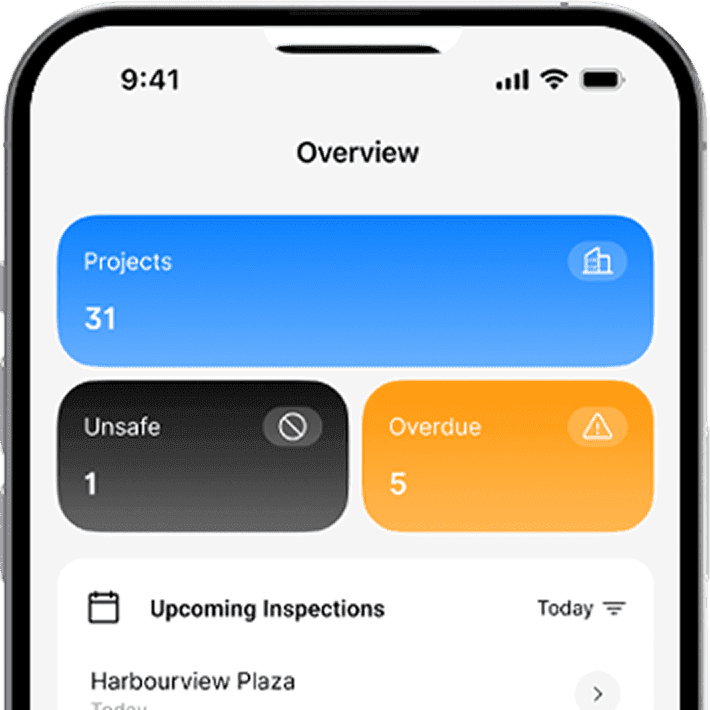
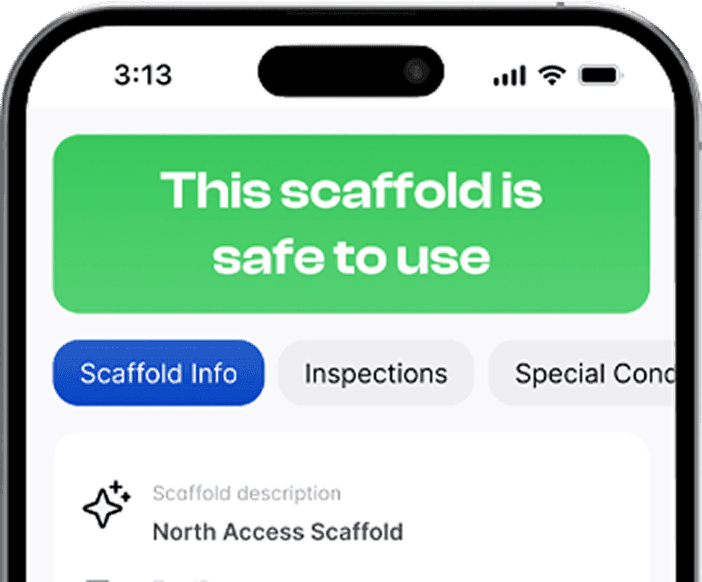
One tag, the whole scaffold record
Scafflinq keeps the scaffold, its handover and every inspection since behind a QR scafftag anyone on site can scan. Start free with 5 tags.