Scaffolding Inspections: What You Need to Know
7 Sept 2023
Updated 17 Aug 2026
By Scafflinq Team
Scaffolding inspections are how a temporary structure is proven safe to use—and kept that way. They are also a legal requirement with real penalties behind them. This is the practical version of what you need to know: how often scaffolds must be inspected, what a compliant inspection actually produces, what non-compliance costs, and why the record matters as much as the check itself.
How often scaffolds must be inspected
In most of Australia, WHS regulations require a competent person to inspect a scaffold before it is first used, after any alteration, repair, impact or severe weather that could affect its stability, and then at least every 30 days while it stays in service. Thirty days is a maximum interval, not a target—a busy scaffold that is frequently modified needs checking far more often. (Victoria sits outside the harmonised WHS laws and sets its own duties under the OHS Regulations.) Many principal contractors go further still: on government, large commercial and mining projects, weekly inspections are a common contractual requirement on top of the statutory minimum.
What a compliant inspection produces
An inspection is not just a look—it produces evidence. Two things in particular:
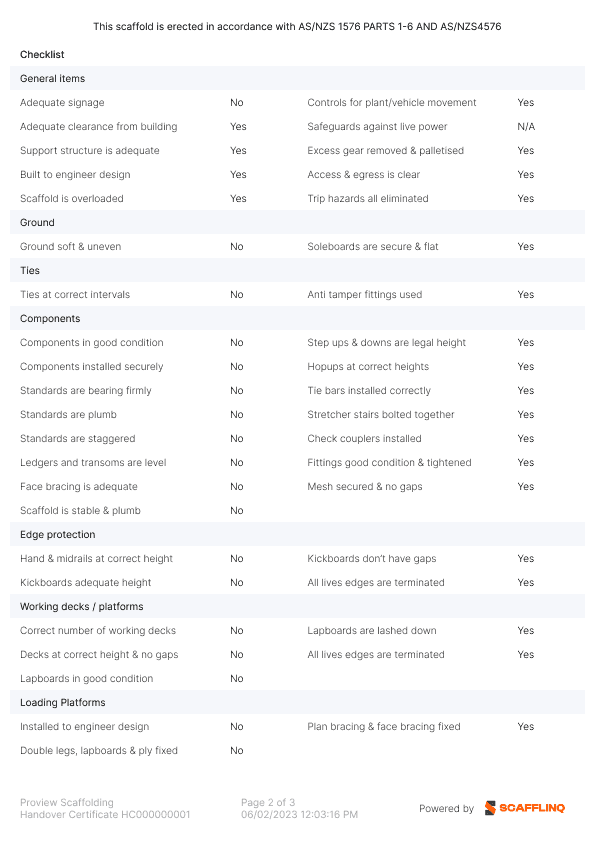
- A handover certificate, issued when a scaffold (or a stage of it) is completed and handed to the builder, confirming it was erected and inspected to standard and is safe to use.
- A scafftag, fixed to the scaffold and signed by the competent person who inspected it, showing at a glance that the scaffold has been checked, when, and by whom—or flagging it clearly when it is not safe to use.
Together they answer the only question that matters on site: is this scaffold safe to be on right now? Regular inspections are what keep that answer "yes".
The cost of non-compliance
When a scaffold fails an inspection, the immediate step is to tag it out and stop access—necessary, but costly downtime while it is rectified. Only a competent, ticketed scaffolder may alter it; anyone else tampering with it is itself an offence. And the regulatory exposure is significant. Under the model WHS law, a Category 1 offence carries a maximum penalty of $21,274,000 for a body corporate and up to 20 years' imprisonment for an individual, and industrial manslaughter is now a criminal offence in most states and territories, with fines reaching around $20 million. That is before the wider economic fallout of an incident—claims, delays and higher premiums—which usually dwarfs the fine itself.
Why the record matters as much as the inspection
The scaffolding company is responsible for keeping inspection records available for audit by Safe Work Australia or the relevant state regulator. That is where traditional paper-and-plastic systems are weakest: a signature on a plastic insert can be forged, and tags get lost, weathered or deliberately discarded—so the moment you need to prove an inspection happened is exactly when the evidence is hardest to produce. The gap between plastic and digital scafftags is really a gap in proof.
Where Scafflinq fits
Scafflinq closes that gap. It gives every scaffold a digital scafftag that cannot be lost or forged, runs the inspection checklist on a scaffolder's phone with photo evidence attached, and keeps a timestamped, tamper-evident history for every scaffold—available to the office in real time and to a regulator on demand. Reminders flag any scaffold approaching its next inspection, so nothing quietly lapses. It is available on Google Play and the App Store, and you can see the full feature set for the detail. It is the same shift from paper to digital records that has already reshaped the rest of the industry.
The bottom line
Scaffolding inspections come down to three things: inspect on time, tag and certify the result, and keep the record. Get those right and a scaffold is provably safe and your compliance is defensible; get them wrong and the downside runs from downtime to a criminal prosecution. The inspection keeps people safe—the record proves you did.