Why Regular Scaffolding Inspections Can Save Lives
17 Jan 2023
Updated 17 Aug 2026
By Scafflinq Team
Falls from a height are the second most common cause of worker death in Australia—about one in eight of all worker fatalities—and construction workers account for close to half of them (Safe Work Australia). Most of those falls are not caused by exotic failures. They come from ordinary, inspectable things: an overloaded platform, a tie that was removed and never replaced, a foundation that has shifted, a guardrail left off after an alteration. That is why regular scaffolding inspection is not paperwork—it is the control that catches those failures before someone finds them the hard way. Here is what a good inspection routine actually does, and why the interval matters.
What "regular" actually means
A scaffold is not inspected once and forgotten. Across most of Australia, WHS regulations require a competent person to inspect a scaffold before it is first used, again after any alteration, repair or event that could affect its stability—a storm, an impact, a heavy load—and then at least every 30 days while it stays in service. Thirty days is a maximum interval, not a target: a busy scaffold that is constantly modified needs checking far more often than that. The point of a fixed interval is to guarantee that no scaffold quietly drifts out of a safe condition without anyone looking.
What an inspection is actually looking for
A competent inspector is working through the specific ways a scaffold fails:
- Overload. Under deadline pressure it is tempting to load a bay beyond its rating. An inspection checks that each platform is within its duty rating and that materials are stacked where the structure can carry them.
- Ties and bracing. Scaffolds rely on being tied to the structure and braced against sway. Ties get removed to run services or move materials and not put back—one of the most common precursors to a collapse.
- Foundations. Sole boards and base plates that have sunk, shifted or been undermined by wet ground turn a stable scaffold into a leaning one.
- Edge protection and access. Guardrails, mid-rails, toeboards and secure platforms are what stop a fall in the first place. Inspections confirm they are complete and were reinstated after any alteration.
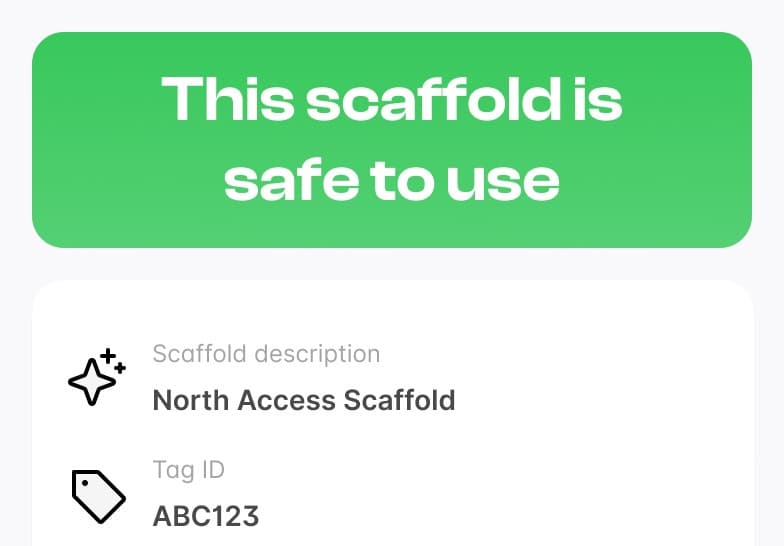
- The tag. A current, legible tag tells everyone on site that the scaffold has been checked and is safe to use—and flags it clearly when it is not.
Catching any one of these early is what prevents the incidents behind the real costs of scaffolding accidents.
When the right call is to shut it down
Sometimes an inspection ends with a scaffold being taken out of service, and that decision can hold up work. It is still the right one. Tagging a scaffold as unsafe and stopping access to it prevents workers from walking onto a structure that looks fine and is not. A short delay is a cost; an incident is a catastrophe. A good inspection culture is one where shutting a scaffold down is treated as the system working, not as a failure.
From ad hoc checks to a system you can prove
The difference between a site that inspects reliably and one that does not is rarely intent—it is system. Checks that depend on someone remembering get missed. A structured routine, with a clear interval, a consistent checklist and a record for every scaffold, is what turns safety from good intentions into something you can rely on—and prove afterwards if you ever have to. This is where digital inspection platforms have made the biggest difference: they make the interval automatic and the record complete.
Where Scafflinq fits
Scafflinq is built to keep that routine reliable. It gives every scaffold a digital scafftag, runs the inspection checklist on a scaffolder's phone, and sends reminders before the next inspection falls due—so a scaffold cannot quietly slip past its interval. The office sees the status of every scaffold on the project, and every inspection is timestamped, photographed and kept. The result is simple: no scaffold goes unchecked, and you can show it.
The bottom line
Regular inspections save lives because they interrupt the small, ordinary failures before they become fatal ones. The fundamentals do not change—the basics every scaffolder should follow still apply—but doing them on a reliable schedule, and recording that you did, is what keeps a temporary structure safe for everyone who steps onto it.