How often should scaffolding be inspected? UK rules and the 7-day check
26 Nov 2026
By Scafflinq Team
In Great Britain, scaffold inspections are set by regulation 12 of the Work at Height Regulations 2005. A working platform used for construction work, from which a person could fall 2 metres or more, must be inspected in position within the previous 7 days before anyone uses it. It must also be inspected after it is erected and after anything that could affect its safety. This guide sets out what the regulation says, who can inspect, and what the written report must include.
When a scaffold must be inspected
Regulation 12 sets three triggers for inspecting work equipment such as a scaffold:
- After erection, before use. Where safety depends on how the equipment is installed or assembled, it must not be used in any position until it has been inspected in that position (regulation 12(2)).
- Every 7 days. A working platform used for construction work, from which a person could fall 2 metres or more, must not be used unless it has been inspected in that position within the previous 7 days. A mobile working platform must have been inspected on the site within that time (regulation 12(4)).
- After exceptional circumstances. Equipment exposed to conditions that cause deterioration must be inspected at suitable intervals, and each time exceptional circumstances liable to jeopardise its safety have occurred (regulation 12(3)). Strong winds, storm damage, an impact or unauthorised alterations are the kinds of event to plan for.
Treat 7 days as the longest gap allowed. A scaffold that is altered, damaged or affected by weather needs inspecting before it is used again, whatever the date of the last inspection.
Who can inspect scaffolding
The regulation defines an inspection as "such visual or more rigorous inspection by a competent person as is appropriate for safety purposes", including any testing needed (regulation 12(10)). It does not name a qualification. The person inspecting needs enough training, knowledge and experience of the type of scaffold to recognise defects and judge whether it is safe to use.
The duties in regulation 12 fall on employers. HSE's summary of the Work at Height Regulations adds that the regulations apply to anyone who controls work at height, including people who contract others to do it.
Industry guidance is clearer on who does what. The National Access and Scaffolding Confederation's guidance note SG35:21 says that once a scaffold is handed over, the client is responsible for the mandatory inspections, such as the 7-day check. NASC recommends agreeing at tender stage who will carry them out, and stating on the handover certificate who is responsible. SG35:21 is industry best practice, not law.
What the inspection report must include
For a construction working platform of 2 metres or more, the person who carried out the inspection must:
- prepare a report before the end of the working period in which the inspection was completed, and
- give the report, or a copy, to the person the inspection was carried out for within 24 hours of completing it (regulation 12(7)).
Schedule 7 lists what the report must contain:
- The name and address of the person for whom the inspection was carried out.
- The location of the work equipment inspected.
- A description of the work equipment inspected.
- The date and time of the inspection.
- Details of any matter identified that could give rise to a risk to the health or safety of any person.
- Details of any action taken as a result.
- Details of any further action considered necessary.
- The name and position of the person making the report.
The employer who receives the report must keep it at the site until the construction work is complete, then at one of their offices for 3 months (regulation 12(8)).
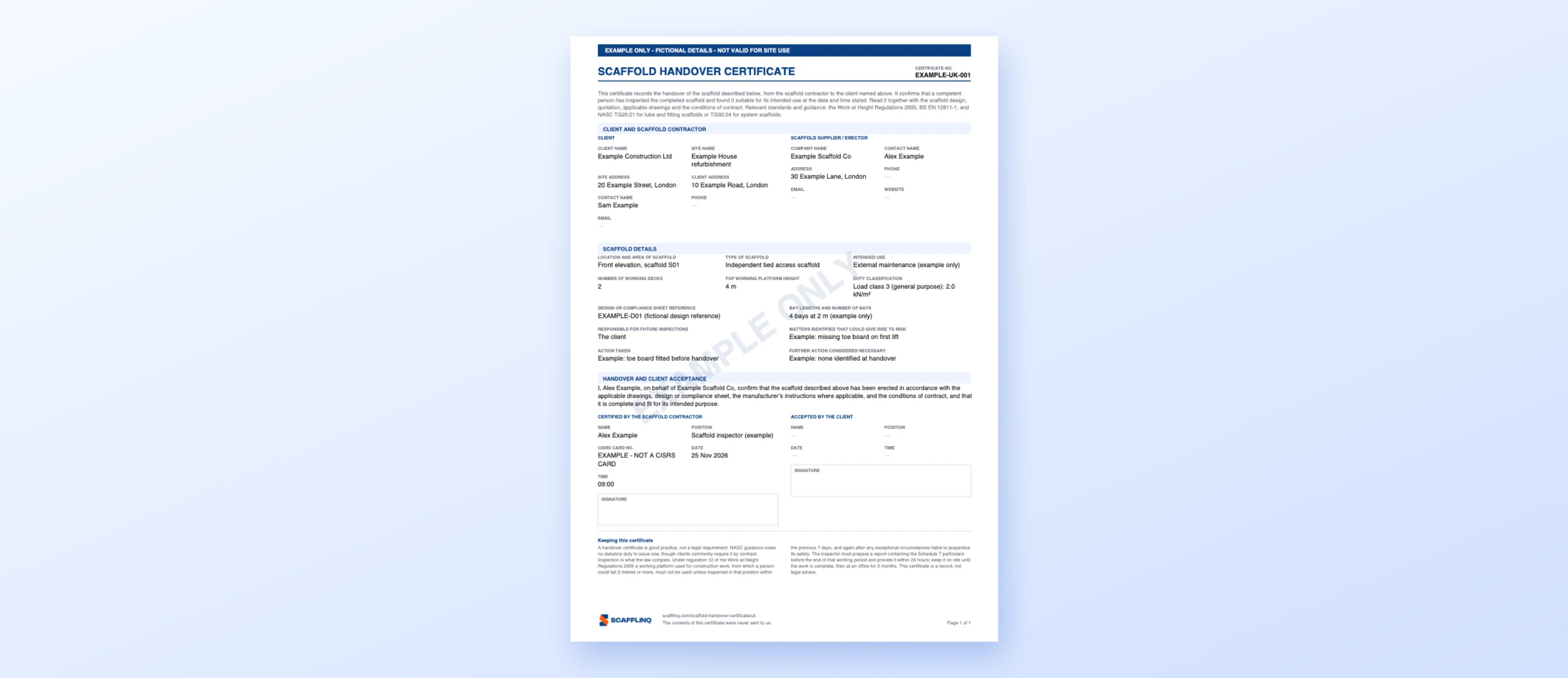
There is no legal requirement for a scaffolding contractor to issue a handover certificate. NASC's SG35:21 recommends that clients ask for one and sign it, and notes that a handover certificate containing the Schedule 7 particulars can serve as the report of the first inspection after erection. The free UK scaffold handover certificate template includes all eight.
Do UK scaffolds need a tag?
The Work at Height Regulations require the inspection and the report. They do not require a scaffold tag. NASC's SG35:21 says inspections and recording them in the scaffold register are mandatory, while tags and electronic scaffold inspection devices are not. NASC does recommend electronic inspection devices as a category. Sites that use tags do so to show workers a scaffold's status before they climb on. Read scaffold tag requirements for what regulators in the UK, Australia, New Zealand and Canada say.
A tag shows status. It does not replace the inspection or the Schedule 7 report.
Keeping 7-day inspections on schedule
Missed inspections usually come down to scheduling: a scaffold stays up longer than planned, the inspector moves to another job, or nobody owns the date. A few habits help:
- Record the date each scaffold was handed over and set the next inspection from it.
- Keep one register of every scaffold standing on each site, with its last and next inspection dates.
- Close off a scaffold that misses its 7-day inspection until it has been inspected.
- Keep reports on site, where the site manager can find them on the day.
Where Scafflinq fits
Scafflinq is a scaffold inspection app for UK contractors. Set a 7-day inspection schedule for each scaffold and the inspector gets app and email reminders before an inspection falls due. Inspections are completed on a phone against your own checklist, with photos and sign-off. Each scaffold's Scafflinq tag turns amber as the next inspection approaches and red when it is overdue, so anyone who scans can see whether it is safe to use.
Before you rely on a digital record as your Schedule 7 report, check that it covers all eight particulars above.
This guide is general information about the regulations in Great Britain, not legal advice. Northern Ireland has its own Work at Height Regulations (Northern Ireland) 2005. If you work in Australia, read scaffold inspections in Australia.