Scaffold height to base ratio in Australia: the 3 to 1 rule
26 Nov 2026
By Scafflinq Team
The "3 to 1 rule" says a free-standing scaffold should be no taller than three times its narrowest base. In Australia there is no single ratio set in law. Safe Work Australia says to use the figure in the manufacturer's, supplier's or designer's information, and the documents that do give numbers set 2 or 3 times the base, depending on the scaffold's height and width. None of the Australian documents we checked sets a 4 to 1 ratio.
What the 3 to 1 rule means
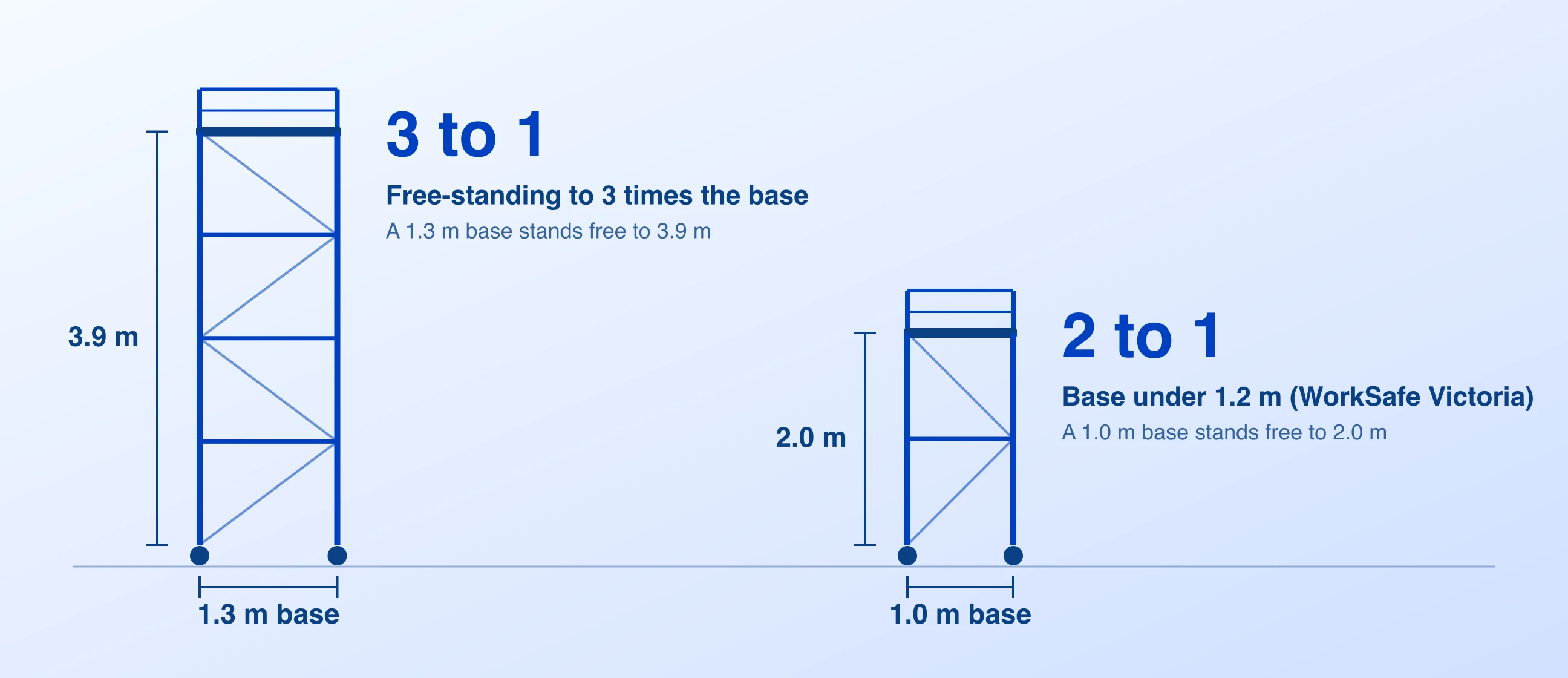
Measure the height from the bottom of the scaffold to the working platform, and compare it with the narrowest side of the base. With a 3 to 1 ratio, a tower with a 1.3 metre base can stand free to 3.9 metres. Any higher and it needs to be tied, guyed or given a wider base.
The ratio changes with the size of the scaffold. Under WorkSafe Victoria's figures, a tower with a 1.0 metre base can stand free to only 2.0 metres, because a base under 1.2 metres drops the ratio to 2 to 1.
What each Australian document says
| Document | Type | What it says |
|---|---|---|
| Safe Work Australia, Tower and mobile scaffolds information sheet (July 2014) | National guidance | Height should be no greater than the multiple of the minimum base dimension in the manufacturer's, supplier's or designer's information. No fixed number. |
| WorkSafe Victoria, Scaffolding Industry Standard (December 2024) | Regulator guidance | Free-standing height up to 2 times the narrowest base width if that width is under 1,200 mm, and up to 3 times if it is over 1,200 mm. Light-duty mobile scaffolds no higher than 9 metres unless the supplier says otherwise. |
| Queensland Scaffolding Code of Practice 2021 | Approved code of practice | Tie an unclad scaffold when it reaches 3 times the minimum base width, unless the design says otherwise. Towers and mobile scaffolds: no higher than the manufacturer or designer specifies. |
| Scaffolding Association Australia, Best Practice Guidelines (Version 1.0) | Industry best practice | During erection and dismantling of an unsheeted scaffold, the smallest base should be at least half the height up to 2 metres, and at least a third of the height above 2 metres. |
| AS/NZS 1576.1:2019 Scaffolding, General requirements | Australian Standard | For a minor scaffold, the platform can be no higher than 2 times the minimum base dimension, and 2 metres at most. |
Safe Work Australia's sheet is the national starting point, and it puts the manufacturer's figure first. Treat the Victorian, Queensland and SAA numbers as the limits those bodies set or recommend, and check what applies in your state. AS 4576:2020, the Australian guidelines for scaffolding, refers to AS 1576.6 for free-standing stability rather than giving a ratio.
Is there a 4 to 1 rule in Australia?
Not in any of the documents above. Some websites describe a "4 to 1 rule" as the Australian standard without naming a source. Pages that quote a 4 to 1 ratio usually take it from US OSHA rules, which do not apply in Australia.
If a manufacturer's instructions allow a higher ratio for a particular tower system, that figure applies to that system. Otherwise, work to the numbers above and the scaffold's design.
When to reduce the ratio or tie the scaffold
Safe Work Australia says to reduce the height to base ratio, or add support, if the scaffold will be:
- sheeted, or likely to be exposed to strong winds
- loaded with heavy equipment or materials
- used to hoist heavy materials or support rubbish chutes
- used for heavy or awkward work, such as grit blasting or water-jetting.
AS 4576:2020 lists the ways to make a scaffold stable: tie it to a supporting structure, guy it, secure counterweights near the base, or add buttress bays to widen the base. Outriggers do the same job on a tower.
Mobile scaffolds
Safe Work Australia's sheet adds a few points for scaffolds on wheels:
- Where adjustable wheels are used, the slope of the surface should not exceed 5 degrees.
- Keep the wheel brakes locked unless the scaffold is being moved.
- Before moving it, check that nobody and no materials are on it, and look for overhead power lines and obstructions.
- Do not move it in windy conditions.
A licensed scaffolder is needed to erect, alter or dismantle a tower or mobile scaffold where a person or object could fall more than 4 metres. Below that, the work should still be done by a competent person.
New Zealand
WorkSafe New Zealand's good practice guidelines set the same 3 to 1 figure. A scaffold must be tied when its height is more than 3 times the width of its base, unless it is rakered or buttressed. For mobile scaffolds, the top working platform should be no higher than 3 times the minimum base dimension for scaffolds over 2 metres, and 2 times for scaffolds under 2 metres.
Where Scafflinq fits
Scafflinq is a scaffold inspection app. Inspections are completed on a phone against your own checklist, with photos and sign-off, so you can add a height to base check for free-standing and mobile scaffolds. For the rest of an Australian inspection, use the free scaffold inspection checklist, and read scaffold inspections in Australia for how often they are required.
This guide is general information, not engineering or legal advice. The manufacturer's, supplier's or designer's figure for a scaffold comes first. Check what applies in your state or territory.